

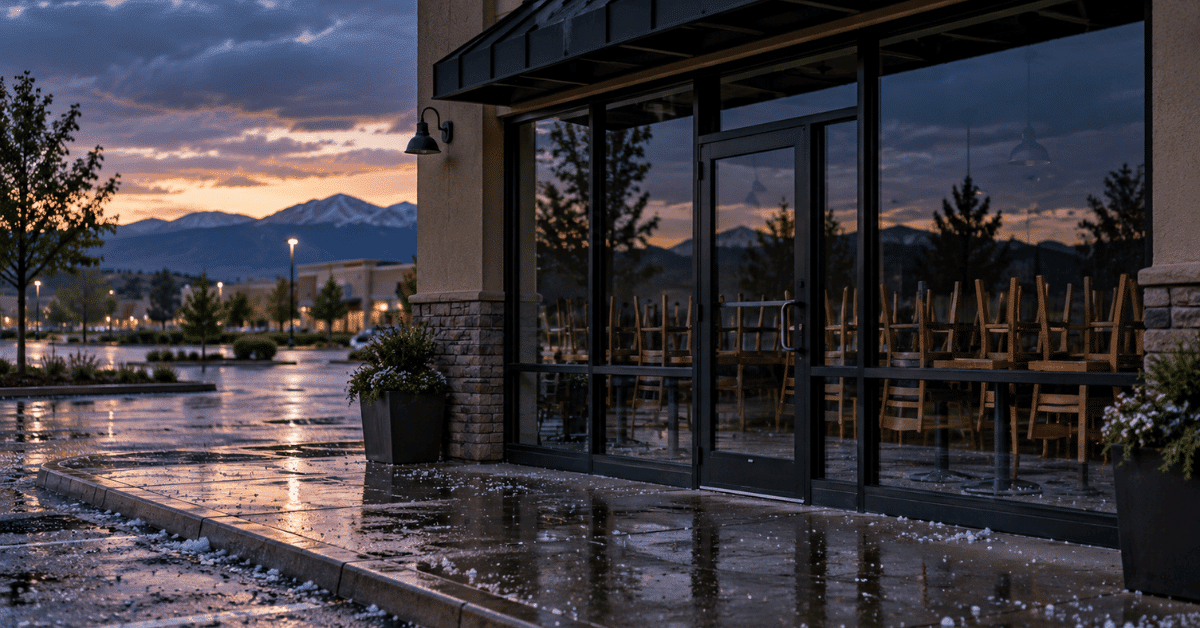
Business interruption insurance in Colorado replaces the income and ongoing expenses a business loses while a covered loss, such as hail damage or a fire, forces it to close or slow down. It does not respond to every shutdown: the standard policy form requires direct physical damage at your premises from a covered cause, and it starts paying lost income only after a waiting period, commonly 72 hours. For a Denver-metro shop, restaurant, or contractor, that gap and the length of the repair decide whether the coverage carries you through.
Most business owners policies (BOPs) include this protection, so BOP coverage is where many small businesses first get it, and a commercial property policy can add it. Below is what has to happen for it to pay, the time limits that shape every claim, how a wildfire closure is treated, and what published price ranges show.
What Has to Happen Before Business Interruption Coverage Pays
The standard ISO business income form pays when three things line up. There is direct physical loss of or damage to property at the premises listed on your policy. A covered cause of loss, such as fire or hail, produced it. And the damage forces a necessary suspension of your operations.
When all three are met, the coverage replaces the income you would have earned and the expenses that keep running while you are down, such as rent, loan payments, and payroll. Extra expense coverage can also pay for costs you would not otherwise have, like renting temporary space so you can keep operating.
A slow month, a lost lease, or a closure with no covered physical damage behind it generally falls outside the coverage. Read the trigger language on your own policy before you assume a closure is covered.
The Three Time Limits That Shape Every Claim
The first limit is the waiting period. Under the standard form, the period of restoration for lost income begins 72 hours after the direct physical loss, while extra expense coverage begins immediately. One national guide reports waiting periods of 24, 48, or 72 hours depending on the policy. Think of it as a deductible measured in time: if hail closes your doors on a Monday morning and your policy has a 72-hour wait, lost income is typically covered from Thursday morning.
The second is the end of the period of restoration. It ends on the earlier of two dates: when the damaged property should be repaired, rebuilt, or replaced with reasonable speed and similar quality, or when the business resumes at a new permanent location. The word “should” matters. The clock follows a reasonable repair schedule, not necessarily the schedule your contractor actually keeps. The standard form also excludes any increased time required because of an ordinance or law that regulates construction, use, or repair, so ask how your policy treats building-code delays.
The third is the tail. The standard form adds extended business income for up to 60 consecutive days after repairs are finished, until operations could produce the income they would have without the loss. An optional extended period of indemnity can replace that 60 days with a longer period shown on your declarations page.
For the wind and hail deductible and what Colorado law says when an insurer delays or denies a claim, see our Colorado hail damage guide.
When Wildfire or a Road Closure Shuts You Down Without Touching Your Building
Civil authority coverage is written for this situation. Under the standard form, it can apply when a covered loss damages other property, authorities block access to the surrounding area because of dangerous conditions from that damage, and your premises are within that area and no more than one mile from the damaged property. Lost income under this coverage starts 72 hours after the first government action and lasts up to four consecutive weeks, while extra expense starts immediately. A Front Range wildfire that triggers evacuation orders is the kind of event this clause is meant to address, but only if your policy includes it and every condition is met.
Do not assume the wildfire protections Colorado has put in place for homeowners carry over to a business. The Division of Insurance’s wildfire consumer advisory describes protections for homeowners policies, including at least 24 months of additional living expense coverage after a total loss in a designated wildfire disaster. It lists no comparable time guarantee for business interruption, so read your own policy’s limits and time periods.
How Premiums Are Set, and What Published Ranges Show
Business interruption coverage is priced on how much income you have at risk, so two businesses on the same Denver-metro street can pay very different amounts. Insurance guides name the same drivers: your revenue and expenses, the value of your property, your industry, your location (wildfire-exposed areas cost more), the limit and restoration period you choose, and your deductible or waiting period.
Insurify reports roughly $450 to $1,560 a year for a business interruption policy. 1-800-Insurance reports $40 to $130 a month for the coverage on its own and around $57 a month when it comes bundled into a BOP. Those are national general ranges from published guides, not Colorado quotes, and your price can fall outside them. The only number that matters is one built on your own revenue and expenses, so ask for a quote before you decide on a limit.
How to Set a Limit That Matches a Realistic Closure
A limit that assumes a two-week closure fails the business that needs five months to rebuild. Work through these steps before you renew:
- Add up your monthly net income plus fixed expenses such as rent, loan payments, and payroll. Insurers verify lost income with tax returns and profit and loss statements, so keep current copies.
- Estimate a realistic rebuild time, including material lead times, and compare it to how the policy defines the period of restoration and treats building-code delays.
- Choose a waiting period your cash reserves can bridge. A longer wait lowers the premium.
- Ask whether an extended period of indemnity is available to replace the standard 60-day tail.
- Ask your broker to confirm that civil authority and extra expense are on the policy and how each is limited.
Your building’s valuation method, replacement cost or actual cash value, is a separate decision that affects the repair bill rather than lost income. Our guide to replacement cost vs. actual cash value covers it.
Frequently Asked Questions
How long is the waiting period on business interruption insurance?
The standard ISO business income form starts paying lost income 72 hours after the direct physical loss and begins extra expense coverage immediately, but waiting periods vary by policy. One national insurance guide reports waiting periods of 24, 48, or 72 hours, so confirm the exact period on your policy’s declarations page.
Does business interruption insurance pay if my building is not damaged?
Generally no, because the standard form requires direct physical loss or damage at the premises listed on your policy, but civil authority coverage can apply when a covered loss damages nearby property and authorities block access. Under the standard ISO form, that coverage requires your premises to be within one mile of the damaged property, starts 72 hours after the first government action, and lasts up to four consecutive weeks.
How long does business interruption insurance pay after a covered loss?
It pays through the period of restoration, which ends when the damaged property should be repaired with reasonable speed or the business resumes at a new permanent location, whichever comes first. The standard ISO form adds up to 60 consecutive days of extended business income after repairs, and your declarations page shows any limit or longer extended period you purchased.
How much does business interruption insurance cost for a small business?
Published insurance guides report roughly $450 to $1,560 a year (Insurify) or $40 to $130 a month (1-800-Insurance) for business interruption coverage, and about $57 a month when it is bundled into a business owners policy (BOP), but these are national general ranges, not quotes. Your price depends on your revenue and expenses, property value, industry, location, limit, restoration period, and waiting period or deductible.
Want a quote built on your own revenue and expenses?