

Colorado’s Division of Insurance issued a consumer advisory on November 5, 2026, after flooding hit southwestern Colorado for the second time in just over a year. The advisory describes proposed emergency regulations open for public comment, written for individuals affected by the floods, not businesses. DOI’s request for comment names one of the proposed rules Prohibited Adverse Actions Applicable to Individuals Impacted by the 2026 Colorado Floods. For Denver-metro and Colorado business owners, the more useful fact is older and simpler: standard commercial property insurance already excludes flood damage, with or without any new state rule, and that gap doesn’t close on its own.
What Prompted the Advisory
A storm carrying the remnants of Hurricane Trudy moved through the Four Corners region starting October 22, 2026, triggering a disaster emergency that Gov. Jared Polis expanded to 12 southern Colorado counties. By October 29, KUNC reported 540 damaged homes and 40 rescue missions and counting. On October 31, Polis requested an expedited federal Major Disaster Declaration; the initial request, covering Archuleta and Rio Grande counties, documents nearly $27 million in FEMA Public Assistance-eligible damage.
What the Advisory Proposes, and Who It’s For
The proposed rules would bar insurers from canceling or non-renewing a property policy because the homeowner can’t return due to flood-caused problems such as inaccessible roads, local rules, or lost utilities; require insurers to cover personal property temporarily moved off the premises at the same amount until the home is reoccupied; and require insurers to expedite covered auto claims. DOI’s own description uses only personal-lines examples — homeowners coverage, “your automobile(s),” and health coverage — stating plainly that “a basic homeowners insurance policy does not include protection from flood damage.” Its protections are written for individual policyholders, not businesses. The public comment period closed November 10, 2026; as of this writing, DOI had not yet published a notice of adoption.
The Coverage Gap Every Colorado Business Already Has
Regardless of what any state advisory covers, Colorado businesses face a standing gap: standard commercial property coverage almost universally excludes flood damage, the same exclusion that applies to homeowners policies. The Brokerage Insurance Group places flood coverage for businesses directly, both NFIP flood insurance and private flood coverage through Neptune, whether or not a business sits inside a mapped flood zone.
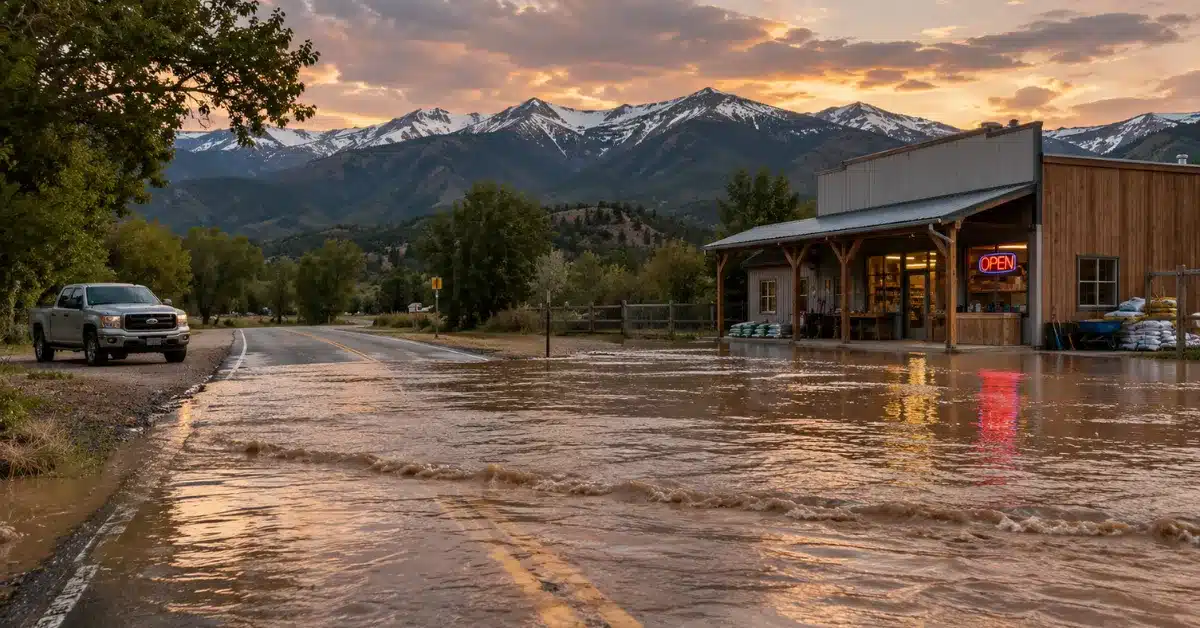
Every time we get a regional flood, I hear from a business owner who never had a drop of water inside their building. The road washed out, customers couldn’t get in, and they lost a week of revenue. They assume business interruption coverage covers that, and usually it doesn’t, because flood is excluded from the standard commercial property form, and both business interruption and civil authority coverage require a covered cause of loss. Civil authority can apply when officials close off access to an area, but only if the underlying damage is from a peril the policy actually covers, and even then the limits are tight. And even a flood policy that includes business income coverage usually requires flood damage at the business’s own location, so if losing access without damage is the real risk, ask specifically whether the policy includes civil authority or ingress-and-egress coverage that names flood. If flood-related business interruption matters to a business, it has to come from flood coverage that includes it, through a flood policy or endorsement, not the unendorsed standard commercial property form.
A Pattern, Not a One-Off
This isn’t southwestern Colorado’s first flood emergency in recent memory. Archuleta County, hit hard again this October, was also at the center of the October 2025 flooding that led to Bulletin B-5.55 and an initial federal aid request covering La Plata, Archuleta, and Mineral counties. That request, after the evacuation of nearly 400 homes and a FEMA-validated $13.8 million in public infrastructure damage, was denied by FEMA in December 2025, appealed, and denied again in April 2026, which the Polis administration said was the first time in 35 years Colorado had been refused a major disaster declaration. No federal decision on this year’s request for Archuleta and Rio Grande counties had been announced as of November 12, 2026. Businesses in flood-prone parts of Colorado shouldn’t plan around the assumption that federal aid, or a state advisory, will close the gap.
What to Check Now
A few questions are worth a business owner’s time this month: Does the current commercial property policy explicitly exclude flood, confirmed with the carrier rather than assumed? Is the business near a mapped flood zone, and does that actually rule out NFIP or private flood coverage? Would a flood-forced shutdown meet the business interruption policy’s physical-damage trigger, and is civil authority coverage realistically available for it? A licensed Colorado broker can walk through all three with a specific policy in hand.
Frequently asked questions
Does Colorado’s proposed flood advisory apply to business insurance?
Colorado’s November 2026 consumer advisory describes proposed emergency regulations written for individuals affected by flooding, not businesses; the regulation itself is titled for “Individuals Impacted by the 2026 Floods.” Colorado business owners shouldn’t assume the same protections will apply to their policies.
Does NFIP flood insurance cover lost business income?
Standard NFIP flood policies cover physical damage to a building and its contents, not lost business income. A Colorado business that wants income protection tied to a flood has to add that through a private flood policy or endorsement that specifically offers it.
Can a Colorado business buy flood insurance outside a mapped flood zone?
Colorado businesses outside a mapped high-risk flood zone in an NFIP-participating community can still buy NFIP or private flood coverage; it isn’t restricted to properties inside a flood zone. The Brokerage Insurance Group places both NFIP and private flood coverage for businesses regardless of zone.
Who handles questions about Colorado’s flood insurance advisory?
The Colorado Division of Insurance’s consumer services team handles questions about the advisory and can be reached through DOI’s website. A licensed Colorado broker can help interpret how it affects a specific policy.