
Home / Contractors Insurance / Electrical Contractors
Electrical Contractors Insurance in Colorado for Denver Metro Electricians
By Rob Whittet, Agency Partner | CO License #342852
Electrical contractors insurance is the group of policies that pays for injuries, property damage, vehicle accidents, and stolen tools tied to electrical work. It is usually built from general liability, workers’ compensation, commercial auto, and tools and equipment coverage. To register an electrical contractor, Colorado’s State Electrical Board asks for evidence of workers’ compensation and unemployment compliance, and project owners set liability limits in their contracts. The Brokerage Insurance Group is an independent Denver metro brokerage that compares 30+ A-rated carriers to place insurance for electricians across Colorado.

⭐⭐⭐⭐⭐
5.0 Google Rating
Licensed & Insured
200+ 5-Star Google Reviews
30+ Years Combined Experience
What Colorado Requires Before an Electrical Contractor Can Register
Colorado registers electrical contractors through the State Electrical Board at the Department of Regulatory Agencies (DORA), under C.R.S. 12-115-110. The Board’s published registration requirements say a contractor must hold or employ a licensed master electrician as the responsible individual for the company. The contractor must also submit evidence of compliance with Colorado’s workers’ compensation and unemployment compensation laws.
Those published requirements do not list a general liability minimum or a surety bond for state registration. For local rules, the Board directs contractors to the city or county where they work. In practice, liability insurance requirements reach an electrician through the contract with a general contractor or property owner, and local licensing rules vary by city and county.
Workers’ compensation is the coverage Colorado law does require. The Division of Workers’ Compensation states that, with limited exceptions, a business with one or more employees must carry it at all times, including part-time employees and family members, and that an uninsured employer can be fined up to $500 for every day without coverage. The Division also tells construction businesses to make sure the contractors they hire meet workers’ compensation requirements. The Brokerage Insurance Group quotes workers’ comp coverage alongside an electrician’s liability policy.
How Denver Licenses Electrical Contractors on Top of State Registration
Denver issues its own contractor licenses and certificates through Community Planning and Development, and the city does not accept contractor licenses or certificates from other counties or states. Denver’s licensing page says the first step toward a contractor license is holding a supervisor certificate or employing someone who holds one, and that a Colorado electrical license will substitute for a supervisor certificate.
Electricians who work across the Denver metro area can face a different license or permit rule in each city, and each general contractor adds its own insurance terms. A licensed broker at The Brokerage Insurance Group can review the contract or permit requirement and match limits, additional insured wording, and certificate language to it.
The Core Insurance for Electricians, and What Each Policy Pays For
General liability insurance pays when electrical work injures someone outside the company or damages property that belongs to someone else. A miswired circuit that scorches a customer’s wall, or a client who trips over conduit staged in a hallway, are the kinds of claims this policy is built for. More on what this policy covers is on our general liability page.
Workers’ compensation insurance pays medical bills and part of lost wages when an employee is hurt on the job. For electricians that means shocks and burns, falls from ladders and lifts, and strains from pulling wire.
Commercial auto insurance covers the vans and trucks that carry crews, ladders, and materials between jobs, which a personal auto policy often excludes or limits when a vehicle is used for business. The details are on our work truck coverage page.
Tools and equipment coverage, written as inland marine insurance, follows meters, testers, and benders to the job site, where a commercial property policy tied to a fixed address usually provides little or no coverage.
A commercial umbrella policy adds limits above general liability and commercial auto when a contract asks for more than the underlying policies provide. Contractors bidding larger commercial work can compare higher umbrella limits before the bid goes in.

Completed Operations Coverage: When a Problem Shows Up After the Job Is Finished
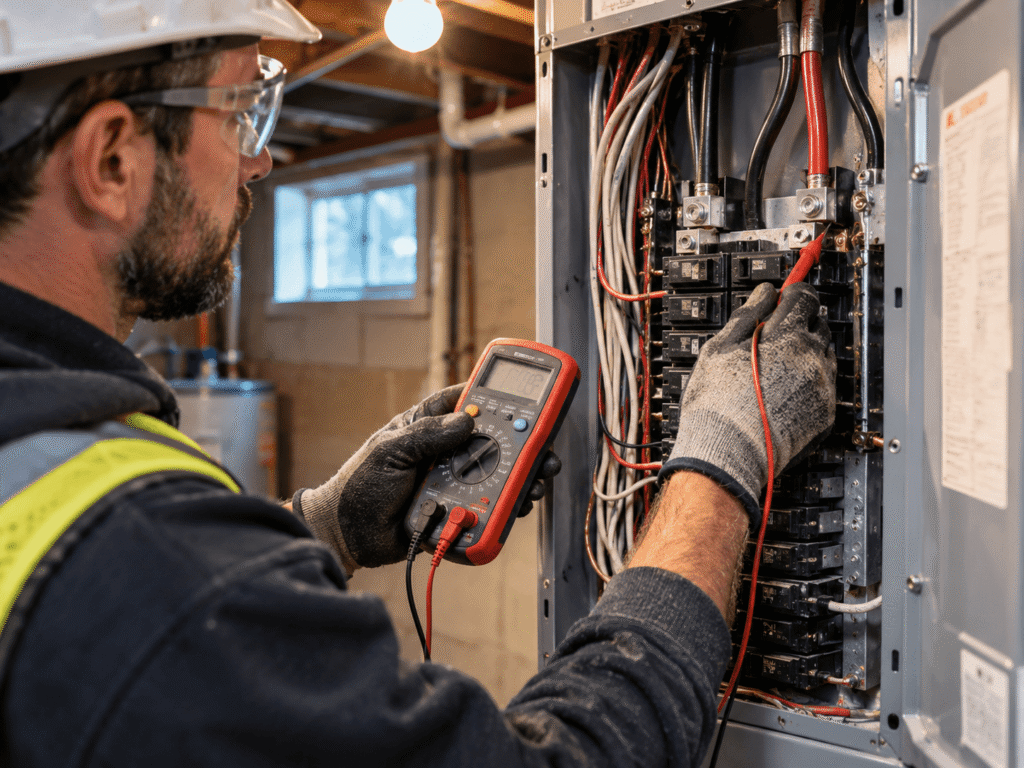
Completed operations coverage is the part of a general liability policy that responds when finished work causes injury or property damage after the electrician has left the site. A wiring fault can sit behind drywall for months before it causes damage.
Under the standard commercial general liability form, these claims draw on their own products-completed operations aggregate limit, separate from the general aggregate. With an occurrence policy, coverage has to be in force when the injury or damage happens, which is why an electrician who lets coverage lapse after a slow season or retirement can be left without protection for past work.
Some contractor policies add exclusions for certain kinds of work, and many contracts require the electrician to keep completed operations coverage and additional insured status in place after the project ends. A licensed broker at The Brokerage Insurance Group can review those endorsements against the contract before the policy is bound.
What Electrical Contractor Insurance Costs, and What Moves the Price
Electrical contractor insurance is priced policy by policy, so a range is more useful than a single number. Insureon’s published national figures for electricians, updated July 28, 2026, run from about $42 a month for tools and equipment coverage to about $275 a month for commercial auto, with general liability at about $61 a month and workers’ compensation at about $140 a month. Insureon reports them as the median cost of policies for electricians who apply for quotes with it, and says most of its customers have fewer than five employees.
Those are national figures for small shops, not Colorado quotes. The price for a specific contractor moves with the type of work (residential service, commercial, or industrial), payroll and revenue, the number of employees and vehicles, the value of tools, years in business, claims history, the limits and deductibles chosen, and which carriers want that class of work. Colorado ranges for one policy are in our general liability cost guide, and a quote from The Brokerage Insurance Group is built on the contractor’s own numbers.
How The Brokerage Insurance Group Quotes an Electrical Contractor, Step by Step
First, the contractor sends the basics: the state electrical contractor registration, payroll and revenue, the mix of residential, commercial, and service work, a list of vehicles and drivers, and a rough value for tools and equipment. Second, a licensed broker reviews any contract, permit, or certificate requirement the contractor has to meet, along with current policies and loss history.
Third, the broker picks the carriers that write electrical work from a network of 30+ A-rated carriers and compares their quotes side by side. Fourth, the contractor chooses, coverage is bound, and the agency issues the certificates of insurance the general contractor or property owner asked for.
Why Colorado Electricians Place Coverage Through an Independent Broker
The Brokerage Insurance Group is an independent brokerage, not a captive agent, so an electrician’s file is not limited to one insurance company’s appetite. Rob Whittet (Colorado License #342852) and Jarrett Schinbeckler (License #313688) are the Agency Partners, with 30+ years of combined experience, and the agency holds License #604725.
The agency has served Colorado since 2019 from its office at 6300 S Syracuse Way #270, Centennial, CO 80111, and holds a 5.0 rating across 200+ 5-Star Google Reviews. Electricians who also act as the general contractor can see the wider picture in our contractor insurance overview.
Agency License 604725. Rob Whittet 342852. Jarrett Schinbeckler 313688.
Bonds, Certificates, and Other Coverage Electricians Ask About
Public and larger private projects often add bonding to the insurance list, and the thresholds are laid out in our guide to performance bond requirements. General contractors usually ask for specific certificate wording, which is covered in our article on additional insured requirements. The agency’s other commercial lines are listed on our commercial insurance lines page.
Electrical Contractor Insurance FAQs for Colorado Electricians
An electrical contractor in Colorado typically carries general liability, workers’ compensation, commercial auto, and tools and equipment coverage, with a commercial umbrella added when a contract calls for higher limits. Colorado requires workers’ compensation, with limited exceptions, for any business with one or more employees, and the State Electrical Board asks for evidence of workers’ compensation and unemployment compliance to register an electrical contractor. General liability is usually a contract requirement, and local licensing rules vary by city and county. The Brokerage Insurance Group compares these policies across 30+ A-rated carriers for Colorado electricians.
Colorado’s State Electrical Board does not list a general liability minimum in its published electrical contractor registration requirements. The Board’s list calls for a licensed master electrician as the responsible individual and for evidence of compliance with workers’ compensation and unemployment compensation laws, and it directs contractors to their city or county for local requirements. General liability insurance still matters in practice, because general contractors, property owners, and commercial leases commonly ask for proof of coverage before work starts. The Brokerage Insurance Group can match an electrician’s limits to the contract in hand.
Electrical contractor insurance in Colorado is priced by policy and by the details of each business, so no single figure applies. As a national reference, Insureon’s median figures for electricians, updated July 28, 2026, run per policy from about $42 a month for tools and equipment coverage to about $275 a month for commercial auto, with general liability at about $61 and workers’ compensation at about $140, and most of its customers have fewer than five employees. Payroll, type of work, vehicles, tools, claims history, limits, and carrier appetite move the price for a Colorado contractor. The Brokerage Insurance Group builds each quote from the contractor’s own figures.
A self-employed electrician in Colorado who contracts directly with customers has to be registered as an electrical contractor with a licensed master electrician as the responsible individual, and the State Electrical Board’s requirements include evidence of compliance with workers’ compensation and unemployment compensation laws. For construction work, the Division of Workers’ Compensation says a contractor with no employees must be covered by workers’ compensation insurance unless the contractor chooses to reject coverage, which requires meeting the Division’s criteria and filing its rejection of coverage form. General liability is not on the state registration list, but most general contractors and property owners ask for a certificate before a self-employed electrician starts work.
An electrician can be covered for a fire that starts after the job is finished when the general liability policy includes completed operations coverage and the policy is in force at the time the damage happens, subject to the policy’s terms. Completed operations claims draw on their own aggregate limit under the standard commercial general liability form. Coverage can be narrowed by exclusions added to a contractor’s policy, so the endorsements matter as much as the limit. A licensed broker at The Brokerage Insurance Group can review those terms with Colorado electricians before a policy is bound.
An electrical contractor gets a quote from The Brokerage Insurance Group by sending the state registration details, payroll and revenue, a list of vehicles and drivers, a tools value, and any contract or certificate requirement through the quote form. A licensed Colorado broker reviews the file, compares carriers, and explains the options for an electrical contractor in Colorado. Selecting GET A FREE QUOTE starts the request, and the team typically responds within one business day with next steps.
Get an Electrical Contractor Insurance Quote From a Licensed Colorado Broker
Tell us about your crew, your vehicles, and the contract in front of you, and a licensed Colorado broker will show you what each carrier offers. We typically respond within one business day.
Licensed • Insured • 200+ 5-Star Google Reviews • Serving Colorado Since 2019
By submitting this form, you agree to our Privacy Policy. We never share your information with third parties.