

If you’re moving into off-campus housing near CU Denver, DU, or MSU Denver this fall, your parents’ homeowners policy probably doesn’t cover what’s inside that apartment. Coverage that follows a dependent student to a dorm room typically stops the moment you sign your own lease.
What Your Parents’ Policy Actually Covers at School
If you live in a dorm and you’re still a dependent on your parents’ policy, your belongings are generally protected through what insurers call off-premises coverage. The Insurance Information Institute notes that some homeowners policies cap this coverage around 10 percent of the total personal property limit. Certain categories, like jewelry or electronics, often carry their own lower sub-limits inside that cap, so a single laptop and a gaming console can eat up more of the allowance than it sounds like at first. Once you move off campus and sign your own lease, that coverage typically doesn’t follow you. The Insurance Information Institute and the National Association of Insurance Commissioners both note that students living off campus are usually not covered by a parent’s homeowners policy at all.
Why Auraria’s Own Crime Data Matters for What You’re Insuring
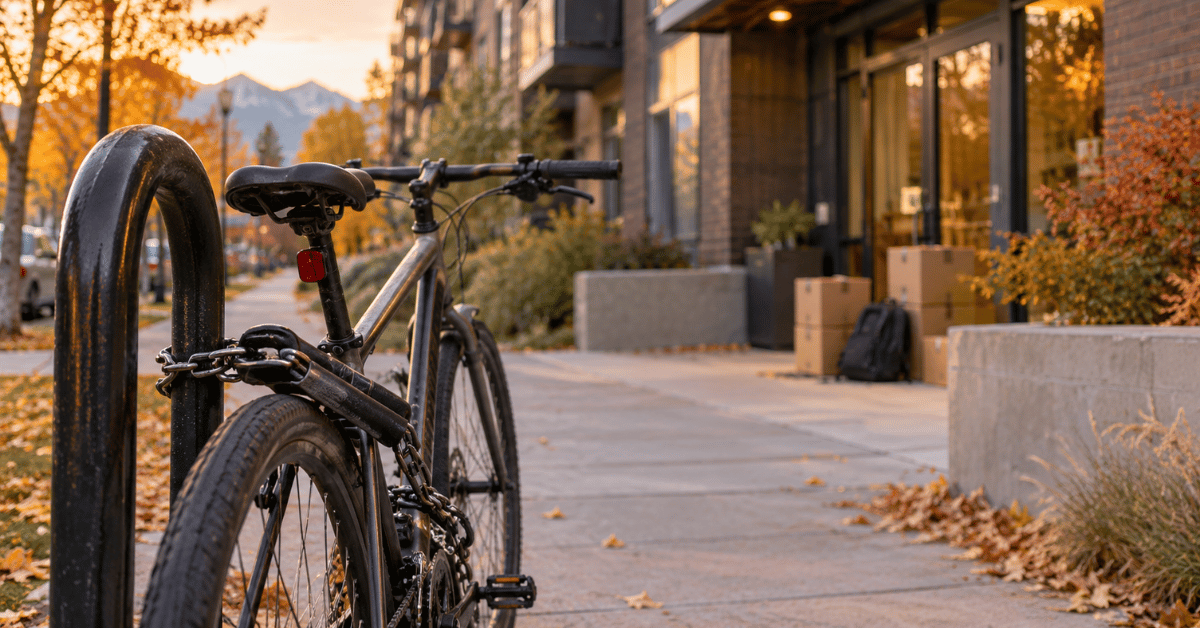
Denver’s own crime-tracking system treats Auraria, the shared campus for CU Denver and MSU Denver, as its own distinct neighborhood, and the numbers there point to a specific kind of risk. Out of Denver’s 78 tracked neighborhoods, Auraria ranks 2nd-worst for property crime and 1st-worst for bike theft. Burglary there sits closer to the middle of Denver’s rankings — the elevated risk here isn’t someone breaking into an occupied unit. Violent crime, driven partly by heavy foot traffic through campus and downtown-adjacent streets, ranks higher (9th-worst out of 78 neighborhoods), but the property-crime and bike-theft numbers are what should drive your coverage decisions: a bike, a laptop, or a car going missing, not a break-in. That combination matters for what kind of coverage actually helps: the elevated risk in this specific area isn’t someone breaking into an occupied unit, it’s a bike, a laptop, or a car getting stolen, which is exactly the category of loss personal property coverage exists for.
The Age and Enrollment Rules Nobody Reads
Even the dorm-year version of this coverage comes with conditions most families never check until they need it. Insurers commonly cap dependent coverage at students under 26, and it typically requires full-time enrollment, defined by the school as usually 12 or more credit hours a semester. Drop to part-time, take a gap year, or turn 26 mid-lease, and that coverage can end without much warning. Studying abroad adds another wrinkle: some policies extend the same off-premises coverage overseas, while others exclude it or cap it lower, so it’s worth a direct question to the agent before a semester abroad rather than an assumption either way.
What a Renters Policy Actually Adds
A standalone renters policy covers what a parent’s off-premises coverage doesn’t reach once you’re off campus: your laptop, bike, furniture, and textbooks against theft, fire, and covered water damage. It also adds personal liability, which a parent’s off-premises extension does not carry with you the same way. If a friend slips on a wet floor in your kitchen and needs stitches, or you accidentally start a small fire that damages a neighboring unit, liability coverage is what stands between that bill and your own pocket. Most policies also pay for temporary housing if a covered loss makes the apartment unlivable for a stretch, which matters more mid-semester than it sounds like it would.
Dorm Coverage vs. Off-Campus Renters Policy
| Living in a Dorm (Parents’ Policy) | Living Off-Campus (Your Own Policy) | |
|---|---|---|
| Coverage source | Off-premises extension of parents’ homeowners policy | Standalone renters policy in your name |
| Typical limit | Often capped at 10% of parents’ personal property limit | Coverage limit you choose |
| Liability coverage | Limited, tied to parents’ policy | Your own liability coverage, separate from parents’ policy |
| Roommate coverage | N/A | Each roommate typically needs their own policy |
| Typical cost | Usually no added cost, bundled into parents’ policy | $15–$30/month (NAIC) |
What Renters Insurance Costs for a Colorado Student
The National Association of Insurance Commissioners puts typical renters insurance premiums between $15 and $30 a month, depending on location and how much personal property you’re covering. That range holds up reasonably well for a typical student’s coverage needs, since most students aren’t insuring much beyond electronics, a bike, and furniture, which keeps the personal property limit, and the premium, on the lower end of that range.
Whose Name Goes on the Policy When You Have Roommates
If you’re the only name on the lease, the policy should be in your name. If you’re splitting an apartment with roommates, each person typically needs their own policy, since the Insurance Information Institute notes that a roommate or partner isn’t automatically covered under someone else’s renters policy unless they’re specifically named on it. That matters most in a claim: if a policy only names one roommate and a different roommate’s laptop is stolen, that loss may not be covered at all.
What Denver-Area Landlords Actually Require
Some off-campus and student-housing landlords in the Denver area require proof of renters insurance before move-in, specifically for the liability coverage it gives the landlord’s own property. Check your lease before assuming it’s optional; requirements like this are increasingly common in off-campus housing markets near large urban campuses, and Denver’s is no exception.
Frequently Asked Questions
Does my parents’ homeowners policy cover me at college in Colorado?
If you live in a dorm and remain a dependent under 26, your belongings are often covered through off-premises coverage, though the Insurance Information Institute notes this is commonly capped at 10 percent of the parents’ personal property limit. Once you move off campus onto your own lease, that coverage typically doesn’t apply.
Do all roommates need separate renters insurance policies?
In most cases, yes. The Insurance Information Institute notes that a roommate isn’t automatically covered under someone else’s renters policy unless specifically named on it, so each person on a shared lease typically needs their own policy.
How much does renters insurance cost for a college student?
The National Association of Insurance Commissioners puts typical renters insurance premiums between $15 and $30 a month, depending on location and how much personal property is covered.
Is renters insurance required for off-campus student housing in Denver?
It depends on the lease. Some off-campus and student-housing landlords require proof of renters insurance before move-in; check your specific lease terms rather than assuming it’s optional.
Is Auraria a high-crime area for CU Denver and MSU Denver students?
Auraria ranks 2nd-worst of Denver’s 78 tracked neighborhoods for property crime and 1st-worst for bike theft, according to Denver’s own crime-tracking data. Burglary there is closer to the middle of the rankings (34th of 78), though violent crime ranks higher, at 9th-worst. The practical takeaway for renters insurance: theft of belongings, not a break-in, is the risk most worth covering, though the personal liability piece of a policy matters here too given the elevated violent-crime rate.
Does renters insurance still cover a student studying abroad for a semester?
It depends on the policy. Some extend off-premises coverage overseas at the same limits, while others exclude certain perils or cap coverage lower, so confirming with the agent before departure is worth the five-minute call.