

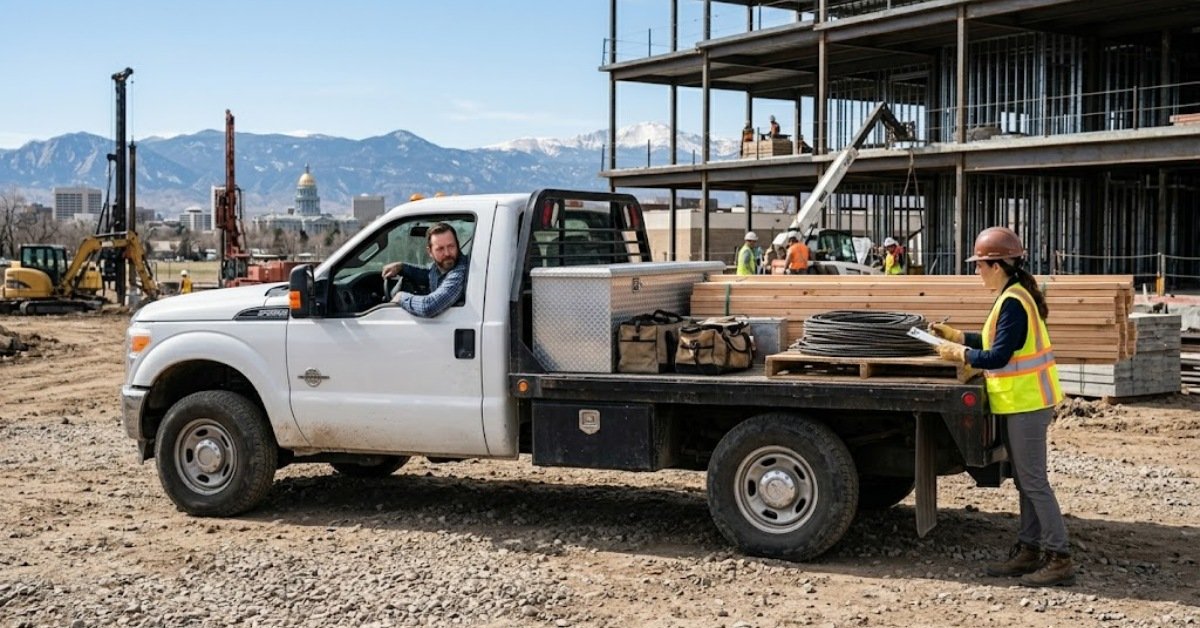
Colorado contractors who use any vehicle for work purposes need commercial auto insurance because personal auto policies exclude business use and will not pay claims that arise from job-related driving. Colorado state law requires a minimum of $25,000 per person and $50,000 per accident in bodily injury liability plus $15,000 in property damage liability for all business vehicles, but most Front Range contractors and general contractors require subcontractors to carry $1,000,000 combined single limit (CSL) before they can access a job site. Understanding what commercial auto covers, what it costs in Colorado, and how fleet policies work differently from single-vehicle policies will help you avoid a coverage gap that could threaten your contracting business.
Why Personal Auto Insurance Does Not Cover Contractor Work Vehicles
A standard personal auto policy written in Colorado excludes coverage for vehicles used in the course of business operations. That exclusion applies whether the vehicle is owned by your business or personally owned by you or an employee. If an HVAC technician drives a company van to a job site and causes an accident, a personal auto policy will deny the claim because the vehicle was being used for business purposes at the time of the loss.
According to the Colorado Division of Insurance (DORA), all business-owned vehicles in Colorado must be covered by commercial auto insurance. For contractors, this means every truck, van, utility vehicle, and trailer that is used to transport tools, materials, or employees between job sites needs to be scheduled on a commercial auto policy with appropriate limits.
The risk is compounded by the nature of contractor work. A single accident on a busy Denver street or on I-70 heading to a mountain project can produce claims for vehicle damage, bodily injury, medical expenses, and lost wages that far exceed what minimum state limits cover. When the vehicle involved is a business asset operated by an employee, the liability exposure extends to the business entity itself.
State Minimums vs. What Contracts Actually Require
Colorado requires all commercial vehicles to carry liability coverage at minimum limits of $25,000 bodily injury per person, $50,000 bodily injury per accident, and $15,000 property damage per accident. These state minimums represent the legal floor, not a practical protection level for most contractor operations.
The real-world requirement for most Colorado contractors is significantly higher. General contractors on Front Range commercial projects and large residential developments routinely require subcontractors to show a certificate of insurance with at least $1,000,000 CSL before any work begins. Mountain resort projects and government work orders often call for $2,000,000 or more. Carrying only the state minimum limits while bidding on commercial contracts means turning away work because you cannot satisfy the certificate of insurance requirement.
For contractors whose employees sometimes drive their own personal vehicles for work errands or supply runs, hired and non-owned auto (HNOA) coverage fills a critical gap. HNOA covers your business’s liability when an employee causes an accident while driving a personal vehicle for work purposes. Without it, a single such accident can expose your business to a claim that neither the employee’s personal policy nor your commercial auto policy will cover.
What Does Commercial Auto Insurance Cost for Colorado Contractors in 2026
Work truck and van coverage for Colorado contractor operations typically runs between $1,800 and $3,500 per vehicle per year for most contractor trades, according to commercial auto insurance market data for Colorado contractor trades compiled from carrier quotes in 2026. Higher-risk operations, vehicles with poor driver records, and businesses garaging vehicles in high-theft Denver metro zip codes can pay considerably more.
| Vehicle Type / Use | Estimated Annual Cost (CO) | Notes |
|---|---|---|
| Light pickup / service van (contractor use) | $1,800 – $3,500 per vehicle | $1M CSL; clean driver record |
| Delivery / cargo van (frequent stops) | $3,000 – $5,500 per vehicle | Higher frequency; metro routes |
| Heavy work truck (dump, flatbed) | $4,000 – $8,000+ per vehicle | Higher severity; towing exposure |
| Fleet policy (5+ vehicles) | Per-vehicle rate improves 10–20% | Volume discount; single renewal |
| HNOA add-on (non-owned/hired autos) | $200 – $600 per year | Covers employee personal vehicles used for work |
Sources: Colorado Division of Insurance (DORA) at doi.colorado.gov; Logrock commercial auto cost analysis 2026.
The most important factors that move your premium in Colorado are the driver motor vehicle records (MVR) of everyone who operates your vehicles, the zip code where vehicles are garaged overnight, your annual mileage and operating radius, the class of use (contractor service vs. delivery), your liability limits and deductible selection, and your prior claims history. Two contractors with identical trucks in the same trade can receive very different quotes depending on driver history and garaging location alone.
Single-Vehicle Policy vs. Fleet Policy: What Colorado Contractors Need to Know
Most commercial auto carriers define a fleet as five or more vehicles under one policy. Moving to a fleet structure brings real advantages for Colorado contractors who have grown beyond two or three vehicles.
With a fleet policy, all vehicles renew on a single date, which simplifies administration and certificate of insurance management. Underwriters also look at the fleet as a pool of risk rather than pricing each vehicle individually, which can improve your per-vehicle rate when the overall loss history is clean. The trade-off is that a single bad actor on your driver list affects the entire fleet premium at renewal.
For contractors below the fleet threshold, adding vehicles one at a time to a commercial auto schedule is the standard approach. Each vehicle should be added before it is driven for business use, not after. An unscheduled vehicle involved in a work-related accident will not be covered regardless of how similar it is to other vehicles already on the policy.
Colorado contractors who also need coverage for tools, materials, and equipment transported in their vehicles should ask about adding a tools and equipment endorsement or a separate inland marine policy. Standard commercial auto policies cover the vehicle itself and liability, but the contents inside the vehicle require separate inland marine coverage. Theft of tools from a parked work truck is one of the most common claims Colorado contractors face, and it is specifically excluded from commercial auto without this additional coverage.
For contractors whose vehicles are part of a larger commercial insurance program, pairing commercial auto with a commercial auto policy review from an independent broker ensures that all vehicles are scheduled correctly and that limits satisfy both state requirements and contract demands.
Fleet pricing varies enormously by vehicle class, driving records, and how your business actually uses each vehicle – factors a generic quote tool doesn’t ask about. An independent broker compares carriers that specialize in contractor fleets instead of running one generic quote.
Commercial auto insurance for contractors is underwritten very differently across carriers. Some carriers specialize in artisan contractors and price pickup trucks favorably. Others penalize any claims in the prior three years regardless of severity. A captive agent representing one carrier cannot tell you whether a competing carrier would write your fleet more favorably at renewal.
An independent broker like The Brokerage Insurance Group in Centennial shops your contractor commercial auto risk across multiple A-rated carriers simultaneously. We also review your driver list, pull MVRs with your permission, and present your risk in the most favorable light to underwriters. For contractors with a mixed driver history or prior losses, that presentation matters and can mean the difference between an admitted policy and a surplus lines policy that costs significantly more.
We also make sure every vehicle on your schedule carries the right limits to satisfy the contract requirements you are bidding against. A certificate of insurance that does not meet a general contractor’s requirements will pull you off a job site on the day work is supposed to start. Getting that right before the policy binds is part of what we do every day for Colorado contractors.
Frequently Asked Questions
Do Colorado contractors need commercial auto insurance on every work vehicle?
Yes, Colorado law requires commercial auto insurance on every vehicle used for business purposes, and personal auto policies specifically exclude coverage for work-related driving, meaning any accident that occurs while a vehicle is being used for contracting work will not be covered by a personal policy.
What liability limits do Colorado contractors need on their commercial auto policy?
Colorado state law requires a minimum of $25,000 per person, $50,000 per accident in bodily injury liability and $15,000 in property damage, but most Front Range general contractors and commercial project owners require subcontractors to carry at least $1,000,000 combined single limit (CSL) before allowing them on job sites.
Does adding a fleet policy save Colorado contractors money over insuring vehicles individually?
It depends on fleet size and vehicle mix — most Colorado contractors with four or more vehicles see per-vehicle savings under a fleet policy, but a broker comparison against individual policies is the only reliable way to confirm it for a specific fleet.
How does a fleet policy differ from individual commercial auto coverage for Colorado contractors?
A fleet policy, typically defined as five or more vehicles, places all business vehicles under a single policy with one renewal date and often produces a better per-vehicle rate than insuring each vehicle separately, while also simplifying certificate of insurance management for contractors who must provide COIs to multiple general contractors throughout the year.